
Hello everyone,
I wanted to write up a thing-y to do a final promo for people to keep me in mind for their external supervision needs in 2026  It’s the ratio of my work I’d like to increase in the 2026. Please feel welcome to share my information with anyone you think might be interested.
My ideal supervision setup is very relational, reflective and long-term. You can find out more about my approach at this website’s page on supervision: here!
I love providing (and receiving) supervision. You may call this practice something different depending on your roles such as co-reflection, debriefing, solidarity chats, professional coaching, clinical supervision, external supervision). My background is social work but I welcome people of all helping, caring and healing roles (paid and/or unpaid since any labour is labour).
I provide supervision that is both self-funded (save your receipts for tax-time!) and agency funded.
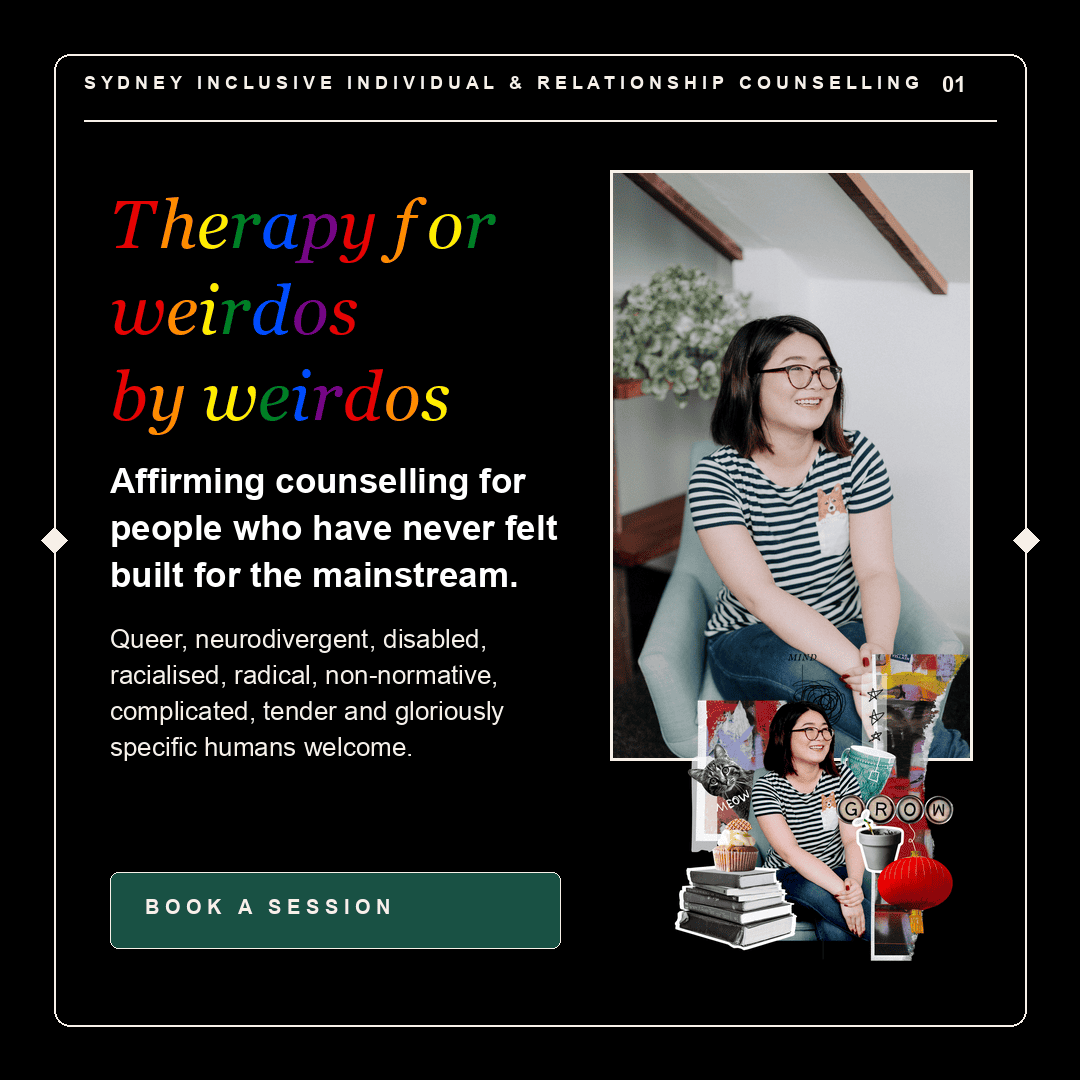
I identify as critical and radical social worker that centres Liberation, Anti-Oppressive Practice, and Trauma-and-Violence-Informed Care.
My experience is primarily in:
- Working with therapeutically with folks marginalised by mainstream society (such as CARM/CALD, LGBTQIA2+SB, disabled folks (neuroaffirming), victim-survivors, people who have caused harm, sex workers, mob/First Nations, sex workers).
- I’m a registered Victims Services counsellor and do see some NDIS clients and can support you in navigating those systems.
- Consultation, coaching and supervision services to for-purpose organisations (and individual service-providers/private practice) to benefit both their staff’s wellbeing and practice, and improve the experience for service-users.
Examples of my 2025 work:
- I ran a Moral Injury workshop for Legal Aid NSW’s pilot specialist service – Disability Legal Support Service on their team day
- Monthly group supervision for Legal Aid NSW’s Allied Professional Services for both their Client Assessment & Referral Service, and the Civil Law Division staff
- Group supervision for Jenny Leong MP: Member for Newtown’s team
- Member of CESPHN’s MHSP (Mental Health and Suicide Prevention) Advisory Committee Meeting
- I have had the privilege to provide supervision and teach classes for multiple universities. I got to teach Deanne Dale’s amazing subject Advanced Social Work Practice SOWK406 about Social Justice Therapies which meant I got to talk about Narrative Therapy and Response Based Practice weekly for 5 months and got paid for it!? What a dream.
Some of micropractices as a relational supervisor and therapist:
- Name power and that time and intention is necessary to build trust, rapport and
safety to share more deeply - I swear and don’t care if you swear
- I will laugh if I find a joke you told funny, sometimes I will joke around
- I will express emotions and feelings and self-regulate (without making you feel responsible for them)
- I will tell the client if something they said triggered an emotion in me – happy, sad, angry, furious, etc. It’s not to centre my feelings but to show you that an emotional response is a reasonable response to the circumstance (e.g. anger at injustices)
- I will name when I’m not doing my best but think I can do a good enough job in session to model humanness, imperfection, self-awareness, and vulnerability.
- I don’t expect you to communicate perfectly – I will assume goodwill and always ask clarifying questions to refine my understandings (it’s my job!)
- I will name people pleasing, or dynamics that are happening in the room/between us
- I will self-disclose to establish safety and connection
- I validate and do not pathologise reasonable/normal human responses to traumatic and/or shitty experiences
- I will send a text or email outside of the session if I see something that made me think of them/we talked about i.e. a meme or a job ad
- I am always ready to receive feedback – praise, constructive criticism, anything. I try to explicitly invite it at the end of sessions but you shouldn’t feel pressure to say anything if you don’t want to
- I will always lean in to repair a rupture and see generative conflict as an opportunity to deepen trust and build safety
- I share parts of myself in the small talk at the beginning and end of sessions when asked. I’m always happy to talk about my cats and how much I hate public transport.